Current Microscopic Analysis
Electric Current
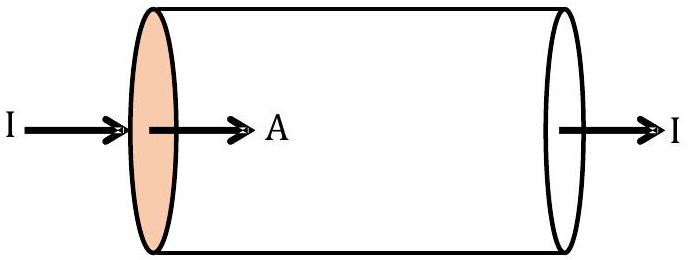
Time rate of flow of charge through a cross sectional area is called Current. If Δq charge flows in time interval Δt then average current is given by
Iav=ΔtΔq
Instantaneous current; I=limΔt→0ΔtΔq=dtdq
⟵ Direction of electron flow
(Conventionally, direction of current is shown from positive to negative)
Direction of current is along the direction of flow of positive charge or opposite to the direction of flow of negative charge. But the current is a scalar quantity.
(-) SI unit of current is ampere and 1 Ampere = 1 coulomb/sec
(-) It is a scalar quantity because it does not obey the law of vectors.
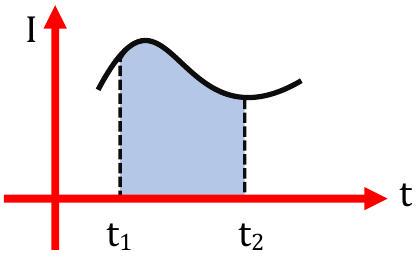
(-) Area under I-t curve provides total charge flow.
Area =∫t1t2Idt=Δq
Current, velocity and current density
Current density at any point inside a conductor is defined as a vector having magnitude equal to current per unit area surrounding that point. Remember area is normal to the direction of charge flow (or current passes) through that point.
(-) Current density J is a vector quantity. It's direction is same as that of E. It's S.I. unit is ampere/ m2 and dimensions [L−2A].
(-) Current density at point P is given by J=dAdIn
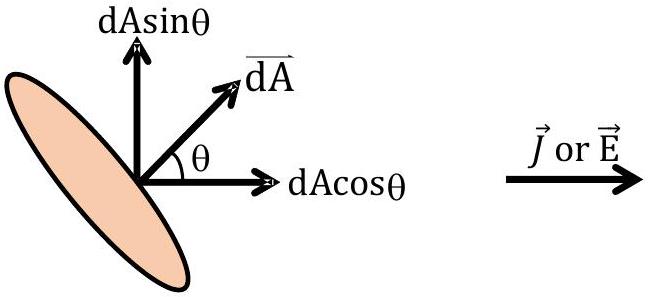
(-) If the cross-sectional area is not normal to the current, but makes an angle θ with the direction of current then
J=dAcosθdI⇒dI=JdAcosθ=J⋅dA⇒I=∫J⋅dA
Illustration 1:
Current through a wire decreases uniformly from 4 A to zero in 10 s. Calculate charge flown through the wire during this interval of time.
Solution:
Charge flown = average current × time
=[24+0]×10=20C
Movement of Electrons Inside Conductor
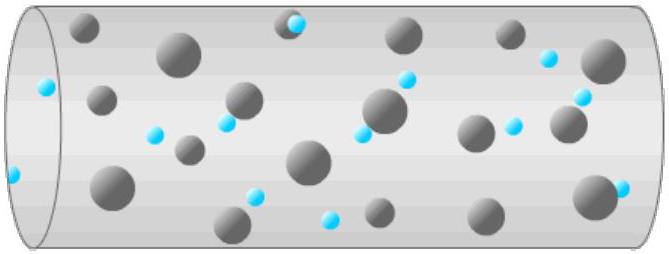
All the free electrons are in random motion due to the thermal energy and relationship is given by
23KT=21mv2
At room temperature its speed is around 106m/sec or 103km/sec
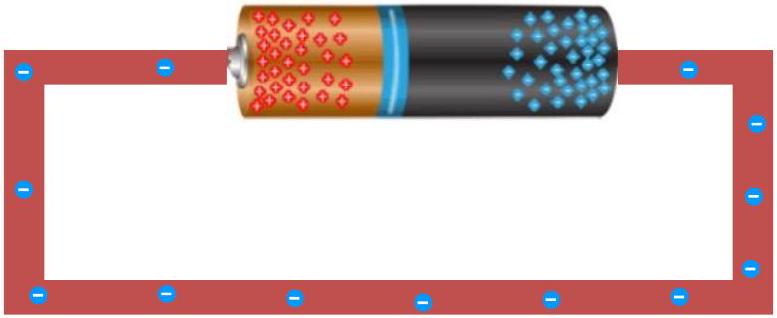
But the average velocity is zero so current in any direction is zero.
When a conductor is placed in an electric field, then for a small duration, electron do have an average velocity but its average velocity becomes zero within short interval of time.
Mean Free Path (λ)
The distance travelled by a conduction electron during relaxation time is known as mean free path λ. Mean free path of conduction electron = Thermal velocity × Relaxation time
λ=Nλ1+λ2….+λN
Order of λ=10A˚.
Relaxation Time (τ)
It is defined as average time elapsed between two successive collisions.
It is of the order of 10−14s. It is a temperature dependent characteristic of the material of the conductor. It decreases with increase in temperature.
τ=Nτ1+τ2+τ3+….τN
Thermal Speed
Conductor contain a large number of free electrons, which are in continuous random motion.
Due to random motion, the free electrons collide with positive metal ions with high frequency and undergo change in direction at each collision. So, the thermal velocities are randomly distributed in all possible directions.
u1,u2,…uN are the individual thermal velocities of the free electrons at any given time.
The total number of free electrons in the conductor =N
Average velocity uave =[Nu1+u2+…uN]=0
The average velocity is zero but average speed is non-zero.
Illustration 2:
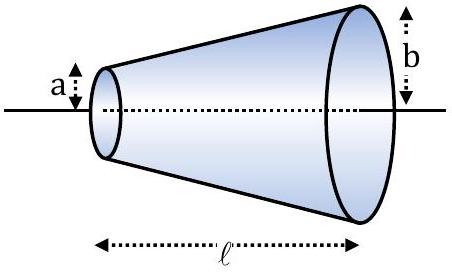
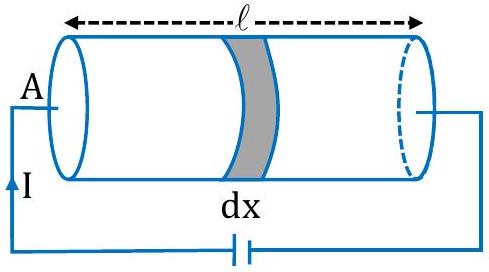
Figure shows a conductor of length ℓ carrying current i and having a circular cross - section. The radius of cross section varies linearly from a to b. Assuming that (b−a)≪ℓ calculate current density at distance ' x ' from left end.
Solution:
Since radius at left end is a and that of right end is b, therefore increase in radius over length ℓ is (b−a).
Hence rate of increase of radius per unit length =(ℓb−a)
Increase in radius over length x=(ℓb−a)x
Since radius at left end is a, radius at distance x is :
r=a+(ℓb−a)x
Area at this particular section A=πr2=π[a+(ℓb−a)x]2
Hence current density =Ai=πr2i=π[a+ℓx(b−a)]2i
Illustration 3:
The current through a wire depends on time as i=i0+αsinπt, where i0=10A and α=2πA. Find the charge crossed through a section of the wire in 3 seconds, and average current for that interval.
Solution:
Illustration 4:
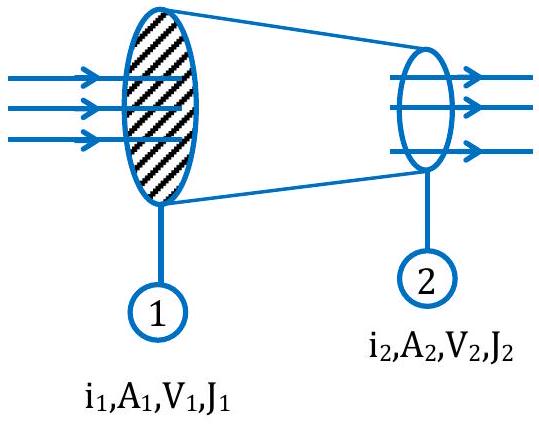
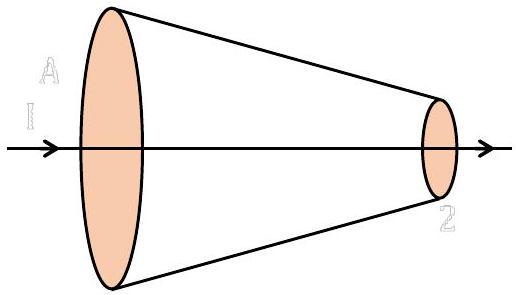
For non-uniform cross-sectional area compare current density at 1 and 2 cross section
Solution:
J1=A1I;A2I;A2<A1⇒J1<J2
Illustration 5:
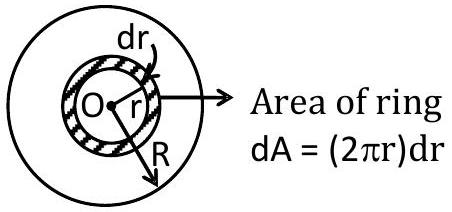
The current density across a cylindrical conductor of radius R varies in magnitude according to the equation J=J0(1−Rr) where r is the distance from the central axis. Thus, the current density is maximum J0 at the axis (r=0) and decreases linearly to zero at the surface (r=R). The current in terms of J0 and conductor's cross-sectional area A is:
Drift Velocity (Vd)
Drift velocity is defined as the velocity with which the free electrons get drifted towards the positive terminal under the effect of the applied electric field.
When the ends of a conductor are connected to a source of emf, an electric field E is established in the conductor, such that E=ℓV
Where V= the potential difference across the conductor and ℓ= the length of the conductor.
The electric field E exerts an electrostatic force- eE on each electron in the conductor.
The acceleration of each electron a=m−eE
Under the action of electric field:
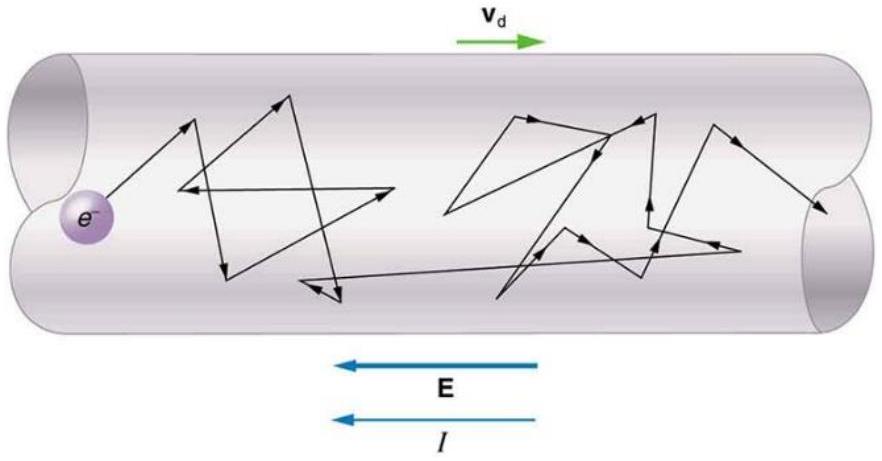
Random motion of an electron with superimposed drift
m= mass of electron e= charge of electron
In addition to its thermal velocity, due to this acceleration, the electron acquires, a velocity component in a direction opposite to the direction of the electric field.
The gain in velocity due to the applied field is very small and is lost in the next collision.
At any given time, an electron has a velocity, v1=u1+aτ1
Where, u1= the thermal velocity
aτ1= the velocity acquired by the electron under the influence of the applied electric field. τ1= the time that has elapsed since the last collision.
Similarly, the velocities of the other electrons are
v2=u2+aτ2,v3=u3+aτ3,…,vN=uN+aτN
The average velocity of all the free electrons in the conductor is equal to the drift velocity vd of the free electrons.
or vd=N(u1+u2+…uN)+aN(τ1+τ2+…+τN) order of drift velocity is 10−4m/s∵Nu1+u2+…+uN=0∴vd=aNτ1+τ2+…+τNr⇒vd=meEτ
Mobility
As we have seen, conductivity arises as a result of mobile charge carriers. In metals, these mobile charge carriers are electrons; in an ionised gas, they are electrons and positively charged ions; in an electrolyte, these can be both positive and negative ions.
An important quantity is the mobility μ defined as the magnitude of the drift velocity per unit electric field:
μ=E∣vd∣
The SI unit of mobility is m2/V−s and is 104 times the mobility in practical units ( cm2/V−s ). Mobility is positive.
vd=meτE⇒μ=EVd=meτ
Where τ is the relaxation time for electrons.
Note:
On increasing temperature of conductor, frequency of collision increases and hence average relaxation time decreases.
Temperature ↑, τ↓
Vd=meEτ,Vd↓σ=mne2τ,σ↓,ρ↑ (Where ρ is resistivity of the material.) μ=meτ,μ↓
Illustration 6:
Find the approximate total distance travelled by an electron in the time-interval in which its displacement is one meter along the wire.
Solution:
Time = drift velocity displacement =VdS
∴Vd=1mm/s=10−3m/s
(Normally the value of drift velocity is 1mm/s )
S=1m time =10−31=103s
distance travelled = speed × time
∵ speed =106m/s
So, required distance
=106×103m=109m
Illustration 7:
A current of 1.34 A exists in a copper wire of cross-section area 1.0mm2. Assuming each copper atom contributes one free electron. Calculate the drift speed of the free electrons in the wire. The density of copper is 8990kg/m3 and atomic mass =63.50.
Solution:
Mass of 1m3 volume of the copper is =8990kg
=8990×103g
Number of moles in 1m3=63.58990×103=1.4×10⁵
Since each mole contains 6×10²³ atoms therefore number of atoms in 1m3
n=(1.4×105)×(6×1023)=8.4×1028= electron density i=neAvdvd=neAi=8.4×1028×1.6×10−19×10−61.34(∵1mm2=10−6m2)=10−4m/s
Illustration 8:
Two wires each of radius of cross-section r but of different materials are connected together end to end (in series). If the densities of charge carriers in the two wires are in the ratio 1 : 4, the drift velocity of electrons in the two wires will be in the ratio:
(A) 1 : 2
(B) 2:1
(C) 4 : 1
(D) 1:4
Solution:
I=neAvd
⇒vd∝n1⇒vd2vd1=n1n2=n14n1=4:1
Ohm's Law
Let the number of free electrons per unit volume in a conductor =n
Total number of electrons in dx distance =n(Adx)
Total charge, dQ=n(Adx)e
Cross sectional area =A
Current
I=dtdQ=nAedtdx⇒I=neAvd
Current density
J=AI=nevdvd=(meE)τJ=(mne2τ)E⇒J=ne(meE)τ⇒J=σE,σ is called conductivity (σ)=mne2τ
In vector form J=σEσ depends only on the material of the conductor and its temperature.
As temperature (T)↑,τ↓
Now
J=AI,σ=mne2τ and E=ℓVI=mℓnAe2τVV=nAe2τmℓIV=IR
So current in conductors is proportional to potential difference applied across its ends. This is Ohm's Law. R has S.I unit ohm (Ω).
Resistivity
It is the property of substance, defined as
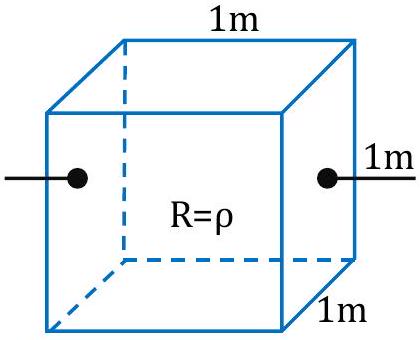
ρ=ℓRA, if ℓ=1m,A=1m2 then ρ=R
It's unit is Ω−m
The specific resistance of a material is equal to the resistance of the wire of that material with unit cross - section area and unit length.
Resistivity depends on:
((i)) Nature of material
((ii)) Temperature of material
ρ does not depend on the size and shape of the material because it is the characteristic property of the conductor material.
ρalloy >ρsemiconductor >ρconductor
Conductivity
It is the measure of the ease at which an electric charge can pass through a material.
It's SI unit is Siemens per meter ( S/m )
It is the inverse of resistivity σ=ρ1
Limitations of Ohm's Law
Although Ohm's law has been found valid over a large class of materials, there do exist materials and devices used in electric circuits where the proportionality of V and I does not hold. The deviations broadly are one or more of the following types:
((a))V ceases to be proportional to I (Fig. 1).
((b)) The relation between V and I depends on the sign of V. In other words, if I is the current for a certain V, then reversing the direction of V keeping its magnitude fixed, does not produce a current of the same magnitude as I in the opposite direction (Fig. 2). This happens, for example, in a diode
Fig-1 : the dashed line represents the linear ohm's law. The solid line is the voltage V versus current I for a good conductor.
Fig-2 : Characteristics curve of a diode. Note the different scales for negative and positive values of the voltage and current.
Fig. 3 Variation of current versus voltage for GaAs.
((c)) The relation between V and I is not unique, i.e., there is more than one value of V for the same current I (Fig. 3). A material exhibiting such behaviour is GaAs. Materials and devices not obeying Ohm's law in the form V=IR, are actually widely used in electronic circuits.
Illustration 9:
Current is flowing from a conductor of non-uniform cross section area if A1>A2. Then find relation between
((a))i1 and i2
((b))J1 and J2
((c))V1 and V2 (drift velocity)
where i is current, J is current density and V is drift velocity.
Solution:
((a))i= Charge flowing through a cross-section per unit time.
∴i1=i2
((b))J=Ai as A1>A2 then J1<J2
((c))J=nevd
vd=neJ as J1<J2 then, V1<V2
Resistance and it's Temperature Dependence
Electrical Resistance
The property of a substance by virtue of which it opposes the flow of electric current through it is termed as electrical resistance. Electrical resistance depends on the size, geometry, temperature and internal structure of the conductor.
We have,
I=mℓnAe2τVI=RVR=nAe2τmℓ
Hence,
R=ne2τm⋅Aℓ
So, here R=Aρℓ
ρ is called resistively (it is also called specific resistance), and ρ=ne2τm=σ1,σ is called conductivity. S.I. unit of resistivity is ohm −m(Ω−m). S.I. unit of conductivity is Ω−1−m−1 also called siemens.
Illustration 10:
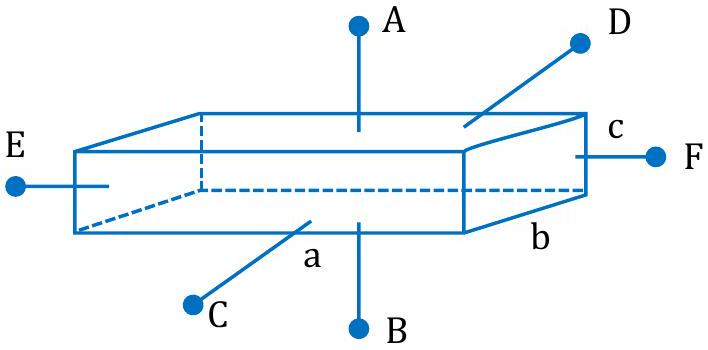
The dimensions of a conductor of specific resistance ρ are shown below. Find the resistance of the conductor across AB,CD and EF .
Solution:
For a condition
R=Aρl= Area of cross section Resistivity × length ⇒RAB=abρc,RCD=acρb,REF=bcρa
Dependence of Resistance on Various Factors
From previous discussion we have:
R=ρAℓ=ne2τm×Aℓ
Therefore, resistance depends on
((1)) length of the conductor (R∝ℓ)
((2)) area of cross - section of the conductor R∝A1
((3)) nature of material of the conductor R=Aρℓ
Results:
((a)) On stretching a wire (volume constant), if length of wire is taken into account then R2R1=ℓ22ℓ12
((b)) If radius of cross section is taken into account then R2R1=r14r24, where R1 and R2 are initial and final resistances and ℓ1,ℓ2, are initial and final lengths and r1 and r2 initial and final radii respectively.
((c)) Effect of percentage change in length of wire
R1R2=ℓ2ℓ2[1+100x]2, where ℓ - original length and x - % increment
If x is quite small (say <5% ) then % change in R is
R1R2−R1×100=(1(1+100x)2−1)×100≅2x%
Illustration 11:
If a wire is stretched to double its length, find the new resistance if original resistance of the wire was R.
Solution:
As we know that R=Aρℓ⇒ in case R′=A′ρℓ′
ℓ′=2ℓA′ℓ′=AℓA′=2A (Volume of the wire remains constant) ⇒R′=A/2ρ×2ℓ=4Aρℓ=4R
Illustration 12:
The wire is stretched to increase the length by 1%. Find the percentage change in the resistance.
Solution:
As we known that,


 But the average velocity is zero so current in any direction is zero.
When a conductor is placed in an electric field, then for a small duration, electron do have an average velocity but its average velocity becomes zero within short interval of time.
But the average velocity is zero so current in any direction is zero.
When a conductor is placed in an electric field, then for a small duration, electron do have an average velocity but its average velocity becomes zero within short interval of time.
 So
So 
 Current density
 Resistivity depends on: