JEE Main 2027 Physics Preparation Plan — Month by Month Guide
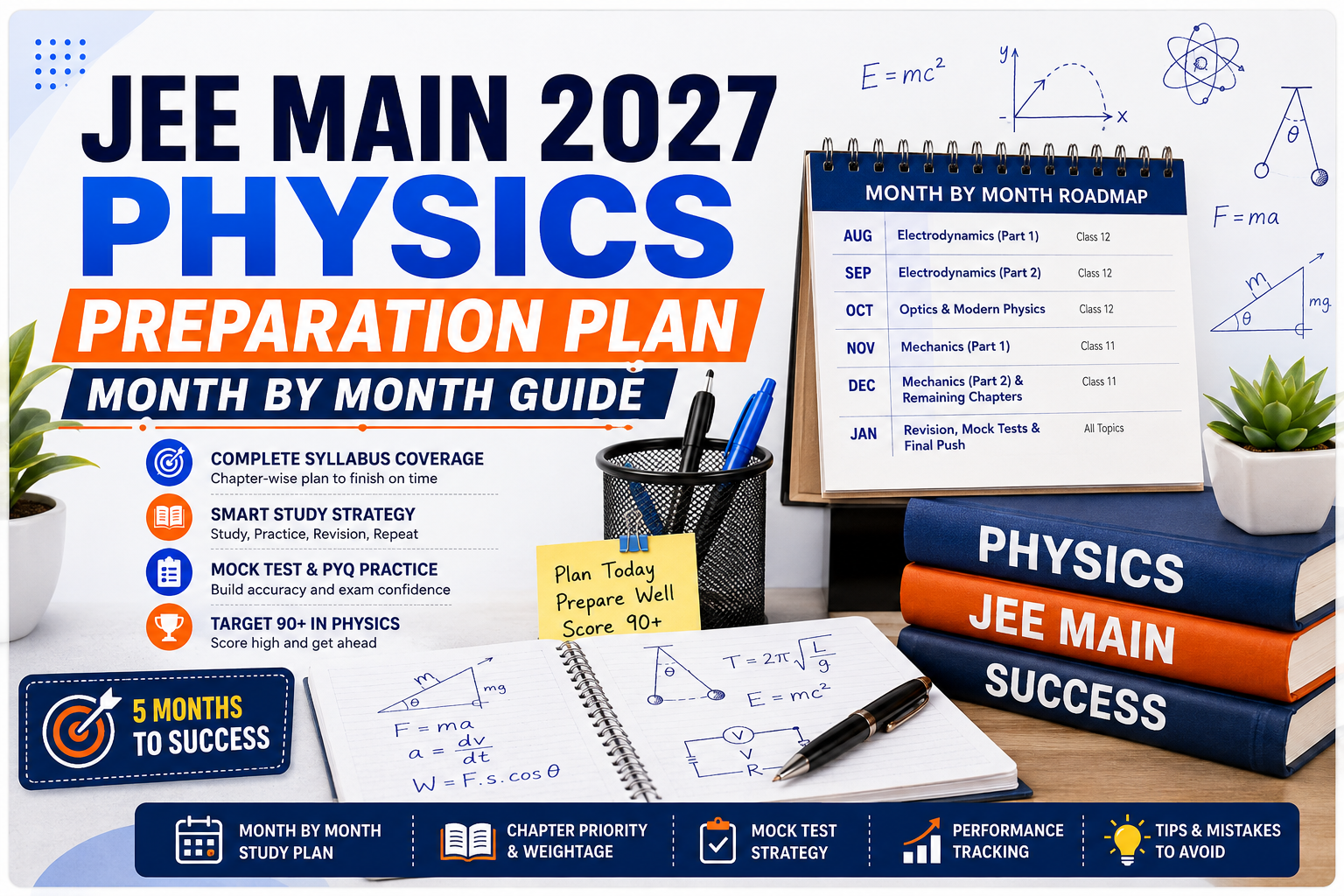
JEE Main 2027 Session 1 is expected in January 2027.
That gives you approximately 5 to 6 months from August 2026.
It sounds tight. And it is if you prepare without a plan.
But here is what we know after working with thousands of JEE aspirants at BestPhysicsTeacher: 5 months of focused, chapter-by-chapter Physics preparation is more than enough to score 90 + in JEE Main Physics.
What destroys preparation is not lack of time. It is lack of structure.
This guide gives you the exact month-by-month Physics preparation plan we recommend for every JEE Main 2027 aspirant starting today.
Related: Complete Guide to JEE Physics Preparation
Before You Begin Set Your Physics Target
JEE Main Physics has 25 questions carrying 100 marks.
Before starting your monthly plan, set a clear target:
| Physics Score Target | Questions Correct | Overall JEE Main Estimate |
|---|---|---|
| 90 + | Maximum 25 questions | 250 plus overall |
| 80 to 89 | Maximum 25 questions | 200 to 249 overall |
| 60 to 79 | Maximum 25 questions | 150 to 199 overall |
We recommend targeting 90 + in Physics as your benchmark. This puts you in a competitive position for NIT admissions and keeps you on track for JEE Advanced 2027.
Now here is your month-by-month plan to get there.
JEE Main 2027 Physics Month by Month Plan
August 2026 Class 12 Electrodynamics (Part 1)
- Chapters: Electrostatics + Current Electricity
- Target: 4 to 5 questions in JEE Main
August is your most important month. Start here, not with easy chapters.
Electrostatics and Current Electricity together contribute the highest marks in JEE Main Physics every single year. Most aspirants either master these or lose 15 to 20 marks here.
Cover Coulomb's law, electric field and potential, capacitors, and Gauss's theorem in Electrostatics. Move to Current Electricity: Ohm's law, Kirchhoff's laws, Wheatstone bridge, and potentiometer.
After every concept, solve NCERT examples and a minimum of 20 previous year JEE Main questions on that topic.
August daily routine:
- 1 hour: new concept from lecture
- 45 minutes: NCERT examples and theory
- 45 minutes: JEE Main PYQs on that concept
September 2026 Class 12 Electrodynamics (Part 2)
- Chapters: Magnetic Effects of Current + EMI and AC Circuits
- Target: 3 to 4 questions in JEE Main
These two chapters are deeply connected; prepare them together.
Magnetic Effects covers Biot-Savart law, Ampere's law, force on a current-carrying conductor, and the moving coil galvanometer. EMI and AC covers Faraday's law, Lenz's law, self and mutual inductance, AC circuits, resonance, and transformers.
JEE Main frequently combines these two chapters in a single question. Practice multi-concept problems from September itself.
September milestone: By the end of September, complete 4 Class 12 Electrodynamics chapters with full PYQ practice.
October 2026 Optics and Modern Physics
- Chapters: Ray Optics + Wave Optics + Modern Physics
- Target: 5 to 6 questions in JEE Main
October covers three chapters but they are among the fastest to prepare per mark gained.
Ray Optics is formula-driven. Mirror formula, lens formula, total internal reflection, and optical instruments. Build a clean formula sheet and practice sign convention problems daily.
Wave Optics covers interference, diffraction, and polarization. Mostly conceptual NCERT examples appear directly in JEE Main every year.
Modern Physics: Photoelectric effect, de Broglie wavelength, Bohr's model, nuclear reactions, and radioactivity are largely formula-based. Students who prepare this chapter thoroughly gain marks that average aspirants consistently lose.
October milestone: By the end of October — 7 chapters complete. Take your first chapter-combined mini mock test covering all completed topics.
Related: Art of Problem Solving in Physics for JEE
November 2026 Class 11 Mechanics (Part 1)
- Chapters: Kinematics + Laws of Motion + Work-Energy-Power
- Target: 5 to 7 questions in JEE Main
November is Mechanics month, and Mechanics is the backbone of JEE Main Physics.
Do not underestimate Class 11. Mechanics alone contributes 25 to 30% of JEE Main Physics marks every year.
Start with Kinematics: motion in a straight line, projectile motion, and relative velocity. Move to Laws of Motion: Newton's three laws, friction, and circular motion. Finish with Work-Energy-Power: work-energy theorem, conservation of energy, power, and collisions.
Every concept in Mechanics requires intensive numerical practice. Reading theory without solving problems will not work here.
November daily routine:
- 1 hour: Mechanics concept from lecture
- 1 hour: numerical problem solving
- 30 minutes: revision of previous month's chapters
November milestone: Start your first full Physics mock test (30 questions, 60 minutes) by mid-November.
December 2026 Class 11 Mechanics (Part 2) and Remaining Chapters
- Chapters: Rotational Motion + Gravitation + Thermodynamics + Waves
- Target: Complete full JEE Main syllabus
December is your completion month. Every remaining chapter gets covered here.
Rotational Motion: moment of inertia, torque, angular momentum, and rolling motion. This is the most concept-heavy chapter in Class 11. Give it extra time.
Gravitation: Kepler's laws, escape velocity, orbital velocity, and gravitational potential energy. Shorter but consistently tested.
Thermodynamics and Kinetic Theory: laws of thermodynamics, Carnot engine, ideal gas, and degrees of freedom. Conceptual and moderate difficulty.
Oscillations and Waves: SHM, wave motion, Doppler effect, and superposition. 1 to 2 guaranteed questions every year.
Semiconductor Electronics: logic gates, p-n junction, transistors. Fast to cover and formula-based.
By December 31: your full JEE Main Physics syllabus must be complete. No exceptions.
December milestone: Full syllabus complete by December 31. Take 2 full mock tests before the year ends.
Related: JEE Main Physics Chapter Wise Weightage 2026
January 2027 Revision, Mock Tests, and Final Push
- Focus: Full revision + intensive mock tests + weak area elimination
- Target: Score 90 + in JEE Main Physics
January is not a study month. It is a performance month.
No new chapters. Only revision, mock tests, and fixing weak areas.
1. Week 1 of January: Revise your formula notebook cover to cover. Revise high-weightage chapters: Electrostatics, Mechanics, Optics. Take one full mock test with complete analysis. 2. Week 2 of January: Solve the last 5 years of JEE Main Physics papers in full exam conditions. Analyse every wrong answer. Focus extra revision on your 3 weakest chapters. 3. Week 3 of January: Mock test every alternate day. After each test, 1 hour of analysis, 1 hour of targeted revision. No shortcuts. No skipping analysis. 4. Final days before JEE Main: Light revision only. Formula notebook, NCERT examples, and 20 quick MCQs per day. Sleep 7 to 8 hours. Do not attempt new resources.
JEE Main 2027 Physics Chapter Priority at a Glance
| Priority | Chapter | Expected Questions |
|---|---|---|
| Must Master | Electrostatics + Current Electricity | 3 to 4 |
| Must Master | Mechanics (All chapters) | 7 to 9 |
| Must Master | Modern Physics | 2 to 3 |
| Must Master | Ray and Wave Optics | 2 to 3 |
| High Priority | Magnetic Effects + EMI + AC | 3 to 4 |
| High Priority | Thermodynamics + Waves | 2 to 3 |
| Complete | Gravitation + Properties | 1 to 2 |
| Complete | Semiconductors + EM Waves | 1 to 2 |
Common Mistakes JEE Main 2027 Aspirants Must Avoid
We see these mistakes consistently at BestPhysicsTeacher.com. Avoid every single one.
- Skipping NCERT examples: JEE Main 2027 will directly test NCERT-level problems. Never skip them.
- Not starting mock tests early enough: First mock should be in mid-November, not January.
- Leaving Rotational Motion incomplete: It is the most skipped and most tested chapter in Class 11.
- Ignoring Semiconductor Electronics: 1 to 2 guaranteed questions; fastest marks available.
- Changing teachers or resources mid-preparation: One teacher. One resource bank. Stick to it.
- Not analysing wrong answers: A mock test without analysis is just wasted time.
Our Recommendation: Best Physics Teachers for JEE Main 2027
At BestPhysicsTeacher, we evaluate every physics teacher on our honest 6-point framework. For JEE Main 2027 aspirants, here are our three recommendations:
Rahul Singh: NIT Trichy graduate with strong JEE problem-solving methodology. Ideal for aspirants who need numerical accuracy and the ability to handle multi-concept JEE Main questions confidently.
Nishant Gautam: MNIT Jaipur graduate with a simple, structured, concept-first approach. Best for students who need to build their JEE Main Physics foundation from Class 11 basics — especially those starting fresh or rebuilding as droppers.
👉 View Profile — Nishant Gautam
Hitesh Gupta: Senior Physics Faculty at ALLEN Kota. Our Rank 1 recommendation for JEE Main and Advanced. His first-principles approach, structured month-by-month syllabus coverage, and personal mentorship make him the ideal teacher for this exact preparation plan.
👉 Compare all teachers at BestPhysicsTeacher.com
Conclusion
JEE Main 2027 Physics is not won by studying more hours.
It is won by studying the right chapters in the right order with daily practice, weekly revision, and consistent mock testing.
Follow this plan from August to January. Complete the syllabus by December 31. Spend January on revision and mock tests. Walk into JEE Main 2027 with 5 months of structured preparation behind you.
That is not hope. That is a plan.
And a plan executed consistently produces results every single time.
Frequently Asked Questions
JEE Main 2027 Session 1 is expected in January 2027. The official NTA exam schedule for 2027 will be released by September to October 2026. Until then, treat January 2027 as your working deadline.
Yes, with the right structure. This month-by-month plan covers the full JEE Main Physics syllabus in 5 months with time built in for revision and mock tests. Consistency and daily practice matter far more than total months available.
Aim for a minimum of 15 to 20 full mock tests before JEE Main. Start chapter-wise mini tests from November. Start full 3-subject JEE Main mock tests from December. By January, attempt a full mock every alternate day.
Start with Electrostatics and Current Electricity; they carry the highest combined weightage. Follow with Magnetism and EMI, then Optics and Modern Physics. Move to Class 11 Mechanics in November.
Follow one primary teacher; switching creates confusion and leaves gaps. Use additional resources like previous year papers and chapter-wise test series only as supplements to your primary teacher's material.